
Surround Sound and the Art of Setup: Where Tech Meets Configuration

Chip Tollefson • February 5, 2026

Learn how our surround sound setup works, why angles matter, and how Entertainment Pros designs room-based audio systems.

You can buy great speakers and still end up with disappointing sound.

We see it all the time. A homeowner invests in a “nice” sound system, turns it on, and the result feels like louder TV sound, not a true movie or music experience. Dialogue is hard to understand. Bass is boomy. Surround effects feel random. Or the system sounds like money was just wasted.

The issue usually isn’t the brand or the price tag. It’s the sound quality comes from two things working together:

  • The technology you choose (speaker type, receiver/amp, subwoofer, processing)
  • The configuration you build (speaker placement, angles, distances, calibration, and room design)

At Entertainment Pros, we treat surround sound like a system, not a box of gear. The goal is not just to install equipment. The goal is to design a sound field which fits your room, your seating, and what you actually love to watch and listen to.

In this article, we’ll walk you through how surround sound really works, why speaker angles matter, how to balance aesthetics with audio performance, and why soundbars improve TV audio but still fall short of true surround sound.

Surround Sound Setup: What “Surround” Really Means

Surround sound is not just having more speakers.

True surround sound means the speakers sit outside the seating area so the listener is enclosed by audio. The goal is to create an immersive sound field where audio can come from the front, sides, and behind you in a way which feels natural.

If all your speakers are in front of you, you can still get better sound than a TV. But you will not get the “you are inside the scene” experience, which makes surround sound special.

Think about your seating area as the center of a circle.

  • The front speakers create the main soundstage: dialogue, music, and the bulk of the action
  • Surround speakers fill the space on the sides and behind you
  • A subwoofer adds depth and impact so sound feels physical, not thin

When surround sound is installed well, it can feel like a sound barrier around the seating area, separating your listening experience from the rest of the room. This is what people mean when they say a system “pulls you in.”

Why the speakers need to be outside the sitting area

Surround sound works because sound reaches you from multiple directions, at the correct timing and volume. If speakers are placed inside the seating zone, or all grouped near the TV (as in “soundbar”), a few things happen:

  • Surround effects don’t appear “around” you- the car sounds in front, not coming from your left side, then pans across in front, and off the screen to the right- like it would in real life.
  • People sitting off-center hear an unbalanced mix
  • The system sounds like “front-heavy audio” instead of full immersion
  • You lose the sense of being encircled, “surrounded”.

A real surround setup is designed so the listener is not just hearing sound from differing locations. Sound surrounds you.

Home Theater Design: What Entertainment Pros Does First

Before we talk angles and placement, here’s the part most people skip. Great surround sound starts long before installation day.

At Entertainment Pros, we begin with room-first design. This means we design the system around your space, not the other way around.

Step 1

We learn how you actually use the room

The best system for a movie lover is not always the best system for someone who mainly listens to music. And a living room install has different constraints than a dedicated theater room.

We ask questions like:

  • Do you care more about movies, sports, gaming, or music
  • Where is the primary seating position
  • How many seats need “great sound” vs “good sound”
  • Do you prefer bookshelf, in-wall or in-ceiling speakers
  • What matters more: maximum performance, clean aesthetics, or a balance

This is important because surround sound is not one-size-fits-all. Your priorities (and your room layout) shape the design.

Learn more about our process here

Step 2

We evaluate the room layout and surfaces

Rooms have personalities. Hard floors, big windows, and open floor plans can create reflections (echos) which will affect clarity. A sectional against the wall changes the surround placement options. A vaulted ceiling impacts overhead sound.

We look at:

  • Room dimensions and ceiling height
  • Seating distance from the screen
  • Reflective surfaces which can cause echo or harshness
  • Where wiring can be hidden cleanly
Step 3

We choose the right equipment for the room, not just the budget

There’s a big difference between a system which fits the room and a system which can simply fits the price range.

When we select equipment, we consider:

  • Speaker type and dispersion (how sound spreads)
  • Power and feature needs based on room size and listening volume
  • Subwoofer output and placement options
  • Receiver capabilities
  • Speaker calibration tools
  • Expandability for future upgrades

This is why professional design matters. Two people can buy the same speakers and get completely different results based on room and setup.

Explore our home theater services

Surround Sound Speaker Placement: Building the “Enclosed” Experience

Once the room is understood and equipment is chosen, we build the sound field.

The goal is simple: surround speakers should be placed around the listening area, not inside it, so the sound stage wraps around you.

A strong surround experience has:

  • A clear front stage (left, center, right) which can anchor to the screen
  • Surround speakers create depth without calling attention to themselves
  • Smooth transitions when sound moves from front to side to rear
  • Bass adds impact without overpowering dialogue

This is where setup and configuration go from “nice to have” to “the whole point.”

Speaker Angles Matter: Best Practices for a Real Surround Sound Setup

Angles change what you hear.

If the angles are right, sound feels cohesive, spacious and intentional. If the angles are off, even expensive gear can sound unbalanced and lack immersivity.

Below are practical best practices we use, with real-world flexibility based on whether you prioritize movies or music.

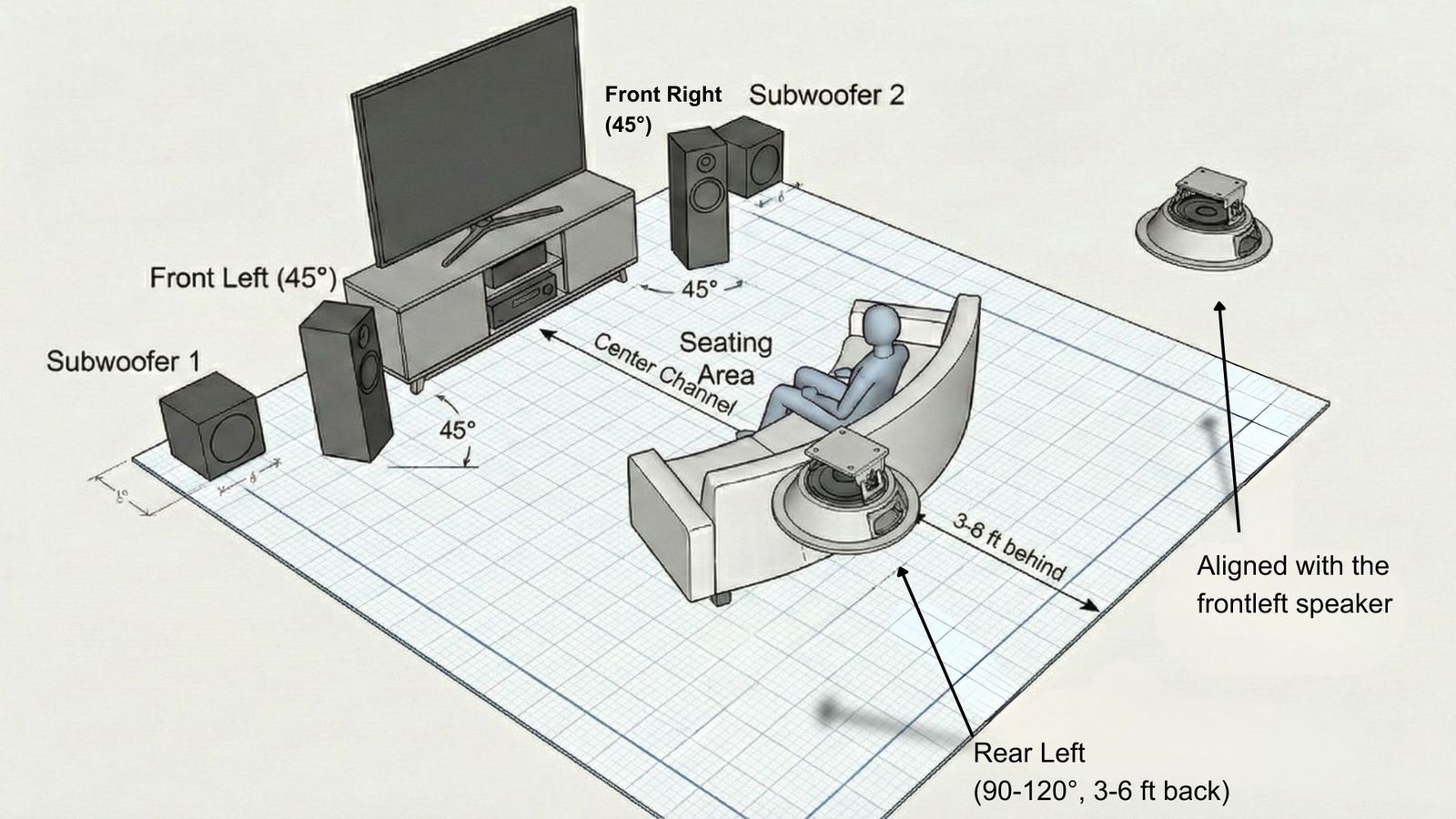
Front left and right speakers: 45 degrees

A solid starting point for many rooms is placing the front left and right speakers around 45 degrees relative to the main listening position. This helps create a wide soundstage without losing clarity.

What you’re aiming for:

  • Voices and key sound effects feel anchored to the screen
  • Music and movies sound wide as if the action happens AROUND you, not IN FRONT OF you.
  • You can “locate” instruments and effects without strain

If your speakers are too wide (which is usually rare), you can get a hole in the middle. Too narrow, and everything collapses into the TV area- it sounds like everything originates just at the TV, not your entire frontal area.

Surround speakers: 60 to 90 degrees

For surround speakers, the goal is immersion.

One of our practices involves utilizing in-ceiling speakers as opposed to bookshelf speakers mounted to a wall. Many rooms don’t have 10’ behind the seating location to get the proper alignment.

If you place them too close (as in speakers on stands behind your sofa), two people enjoying movie night, one person is likely 2’ from one speaker, while the other speaker is 8’ away. That can create a 400% imbalance, not correctable without destroying the soundfield for the other person.

In-ceiling surround speakers, one can be 7’ from the the viewer while the other is 10’ from the viewer, which is much closer to equal (and optimal).

In real living rooms, we also adapt based on seating and walls. Surround sound should feel subtle, like it surrounds you, not like speakers are shouting at your ears.

Speaker aiming: clean surround without visual impact

Speakers often perform best if angled directly at you, but this frequently clashes with the 90 degree angles found in nearly every home and setup, so we work with your home. We want to to sound great, but we also want it to LOOK great.

We like to test and tune on-site. Specs and diagrams are helpful, but your room is the final truth.

Configuration and Calibration: The Part Which Makes It All Click

This is where “surround sound setup” becomes real.

Configuration is how we tell the system what’s connected and how the sound should behave. Calibration is how we make it accurate in your space. All of the receivers we sell have a calibration microphone, but this is only the beginning. Some use the mic and leave it at that. We listen to a few different songs, ask what kind of music you listen to, and set it up for you. This makes a tremendous difference over just the parametric setup microphone sound.

What we configure in a typical surround install:

  • Speaker distances so timing aligns correctly
  • Speaker levels so channels match in volume
  • Crossover settings so bass is clean and controlled as well as speakers only play their proper frequency, increasing longevity
  • Subwoofer integration so low-end feels powerful but not muddy
  • Room correction to reduce problems caused by reflections and room shape

A system can be placed well and still sound off if distances and levels are wrong. Configuration is how we tighten everything up so it sounds intentional.

Why calibration matters for dialogue and clarity

Some people complain about surround effects. MOST complain about dialogue.

When dialogue feels unclear, the fix is often:

  • Center channel positioning and aiming
  • Correct levels and tonal characteristics
  • Room reflections affecting clarity- soften reflections by adding soft, sound-absorptive surfaces
  • Overpowering bass masking voices

Calibration lets us balance the system so you can hear voices clearly with less turning the volume up and down all night.

Aesthetics vs Audio: What Matters More, Your Eyes or Your Ears

This is one of the biggest real-life decisions in surround sound setup.

Some people want maximum performance. Some people want the cleanest look possible. Most want a smart balance.

At Entertainment Pros, we design around what matters to you.

Options to protect your room’s look without killing sound:

  • In-wall speakers for a clean, built-in finish
  • In-ceiling speakers for surrounds or overhead channels
  • On-wall speakers look sleek and produce the best sound
  • Hidden wiring and cable management keeps the room tidy
  • Subwoofer placement planning so it doesn’t dominate the design

The best installs don’t look like a science project. They look intentional, clean, and well-planned.

Why Soundbars Are Better Than TV Sound, But Not Surround Sound

Soundbars are popular because they solve a real problem. TV speakers are limited by thin screens and tiny drivers, firing towards the back wall, then bouncing their way to your ears.

A soundbar usually gives you:

  • Better clarity and louder output-firing directly towards you
  • A wider soundstage than the TV alone- speakers are farther apart, adding immersion
  • Often, improved bass with a subwoofer bundle

So yes, a soundbar is typically a clear upgrade from TV speakers.

Why a soundbar is still not true surround sound

A soundbar is still mostly a front-of-room experience.

Even though soundbars improve your audio, the speakers are not wider than your listening area at the 45 degree angle required to sound like the sound happens AROUND you. Some soundbars also simulate surround, though they are trying to trick your ears using processing. True surround sound uses discrete speakers placed around the seating area, creating real directionality and real movement.

If you want:

  • Surround effects moving around you, not just being “heard” from differing locations
  • Gaming audio helps you locate direction
  • A theater-like experience in your room

A soundbar is a stepping stone, not the destination.

Surround Sound Setup Checklist: Quick Best Practices

Here’s a practical checklist we use as a starting point when planning a room.

Speaker placement basics

  • Keep the seating area inside the speaker layout- between the left and right front speakers, center speaker directly above or below the TV
  • Place surround speakers outside the seating zone, try for in line with the front speakers and behind your seating location. Attempt to keep left and right surround speakers as close to the same distance as possible

Angle basics

  • Front left and right: start around 45 degrees from each other and adjust for imaging
  • Surround speakers: aim for 60-90 degrees apart, but mainly outside and behind the seating area, but work with your room layout
  • Prioritize the main listening position (or 2) first, then improve other seats as possible

Configuration basics

  • Measure distances and set delays correctly
  • Level-match all speakers, sometimes boosting the center slightly to improve dialogue clarity
  • Set crossovers properly to keep speakers playing in their design parameters
  • Integrate the subwoofer carefully so bass supports, not dominates

Take Our Quick Questionnaire

If you want surround sound to fit your room, your seating, and what you love to watch and listen to, the quickest path is a room-based plan.

Take our quick questionnaire to find out the best speaker angles and distances for your room. We’ll help you get a setup which sounds right, looks right, and makes your investment worth it.

Entertainment Pros | Audio Setup Wizard

Entertainment Pros Design Wizard

1. How You Use The Room

A movie lover needs different gear than a music listener. Tell us your priorities.

2. Room Measurements

We use the "45-degree rule" to calculate your soundstage. This requires your seating distance.

3. Design & Aesthetics

Are you looking for high-performance towers or a hidden look?

4. Current Situation

What are you currently using?

5. View Your Results

Almost done! Enter your details to reveal your custom room plan.

Your Optimization Plan

Great news, . Here is how we recommend configuring your room.

Front Soundstage Width
-- ft Place Left & Right speakers this far apart to achieve the ideal 45° angle.
Surround Placement
--
Acoustic Advice:
Design Approach:

We have saved this design to our system.

Home theater with a large screen, seating, and highlighted text: Seamless Connectivity, Smart Integration, Multi-Room Audio.
By Christina Tollefson October 29, 2025
Is your home entertainment system losing its spark? Learn how to upgrade your speakers and TVs for better sound, brighter screens, and smart control.
Entertainment Pros logo next to a speaker being installed in a wall cavity with insulation.
By Christina Tollefson September 12, 2025
Discover how Stealth Acoustics invisible speakers deliver surround sound without the clutter. Free quotes & onsite consultations from Entertainment Pros.
Home theater with a large screen, seating, and highlighted text: Seamless Connectivity, Smart Integration, Multi-Room Audio.
By Christina Tollefson October 29, 2025
Is your home entertainment system losing its spark? Learn how to upgrade your speakers and TVs for better sound, brighter screens, and smart control.
Entertainment Pros logo next to a speaker being installed in a wall cavity with insulation.
By Christina Tollefson September 12, 2025
Discover how Stealth Acoustics invisible speakers deliver surround sound without the clutter. Free quotes & onsite consultations from Entertainment Pros.
Black speaker in a white ceiling, with three radiating vent-like features.
By Christina Tollefson September 4, 2025
A stucco mishap shows why “close enough” isn’t good enough. For AV done right, trust Entertainment Pros in Clearwater, FL.
A TV mounted on a wall, with a swing arm mount. A logo for
By Chip Tollefson August 14, 2025
See how a “pull-down” motorized TV mount solved a tricky glass-walled living room. Entertainment Pros delivers creative TV solutions.
A man is holding a remote control in front of a television.
By Christina Tollefson July 30, 2025
Discover how Entertainment Pros transformed a cluttered condo into a clean, powerful AV setup. Learn how we fine-tune your sound for the best results.
A swimming pool under a thatched roof with a tv on top of it.
By Chip Tollefson July 18, 2025
Enjoy premium outdoor audio solutions designed specifically for Florida weather. Quality sound, expert installation by Entertainment Pros.
More Posts