
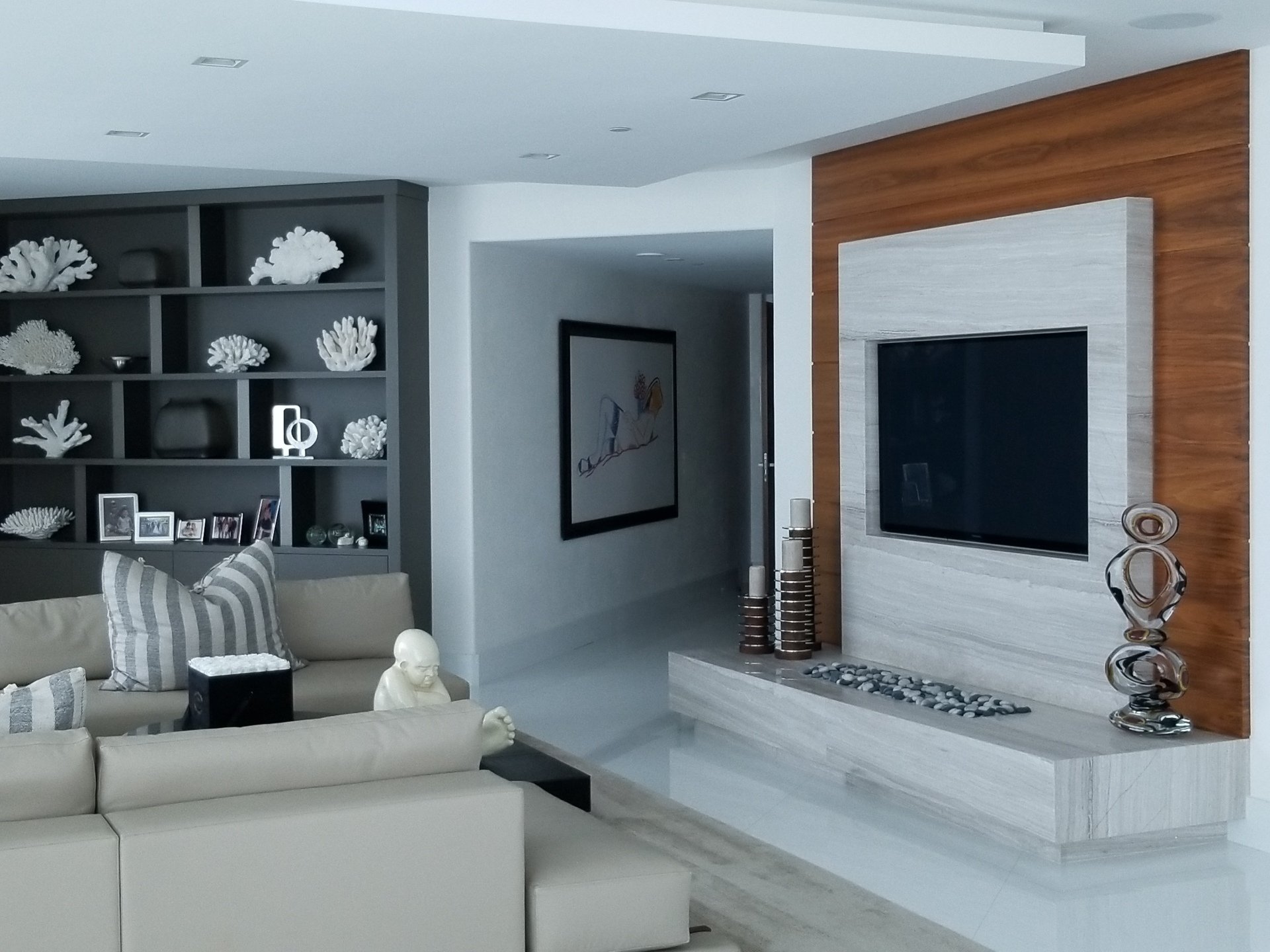
You finally upgraded the TV. The picture is breathtaking — 4K, OLED, all of it. You queue up your favorite show, lean back, and immediately think the same thing every one of our clients eventually says out loud:
"Why does it sound this bad?"
You're not imagining it. Modern TV audio is genuinely worse than it was 20 years ago, and there's a clean physics reason why. We see this in nearly every condo and home we walk into. Here's what's happening behind the panel — and why we won't let a client live with it.
The Problem: Speakers That Fire the Wrong Way
Open up any flagship 2026 TV and find the speakers. You probably can't, because there's no room for them. The panel is 1/4-inch thick at the edges, and there is no longer space inside the bezel for forward-facing speaker grilles.
Manufacturers have one option left: tuck tiny drivers along the back or bottom of the chassis and fire them away from you — into the wall behind the TV, or down at the credenza. The sound bounces, reflects, and (the marketing materials promise) eventually reaches your ears.
It does reach your ears. It just doesn't sound right when it gets there.
The Physics: High Frequencies Don't Bend
Sound waves are not all created equal. Low-frequency notes — bass, the rumble of an explosion — have long wavelengths (10 feet or more for a 100 Hz tone). They wrap around obstacles, including the TV chassis, without much trouble. That's why a backward-firing TV speaker can still produce a vague low-end thump.
But the frequencies that carry intelligibility — the consonants in dialog, the "s" and "t" sounds, the snap of a drum — sit between 2 kHz and 8 kHz. Their wavelengths are inches, not feet. They are highly directional, like a flashlight beam. If the speaker is pointed at the wall, those frequencies hit the wall, scatter, and lose energy before they ever reach you.
That's why dialog from a thin TV sounds muffled and indistinct. The high-frequency information that lets your brain decode speech is literally being shot in the wrong direction.
The Compound Problem: Comb Filtering
It gets worse. The sound that does reach you arrives via two paths: a tiny bit directly, and a much louder copy bounced off the wall behind the TV. Because the wall reflection arrives a few milliseconds later than the direct sound, the two copies interfere with each other. At some frequencies they add. At others they cancel.
This is called comb filtering, and it's the smeared, hollow quality you hear on every modern TV. Your brain can't lock onto a clean signal because there isn't one — it's the same signal arriving twice, slightly out of phase, fighting itself.
The Final Insult: There Is No Cabinet
Even a budget speaker needs a sealed or ported enclosure to produce real bass. The cabinet volume matters as much as the driver. A 1/4-inch thick TV has essentially zero internal volume, so the drivers can't move enough air to produce anything below ~200 Hz. The low end you do hear is mostly distortion from drivers trying to do what physics won't let them.
This is why our clients with $4,000 OLED TVs are routinely shocked when we A/B their built-in audio against a $600 soundbar with proper forward-firing drivers. It's not a small difference. It's a different category of experience.
What to Do About It
There are three reasonable answers and one we won't endorse:
- Soundbar (minimum). A quality bar with forward-firing drivers, a dedicated center channel for dialog, and a real subwoofer fixes the biggest problems. We install soundbars regularly in condos and bedrooms where a full surround system isn't practical.
- Left / Center / Right + subwoofer. Three properly placed speakers plus a sub is the sweet spot for most living rooms. Dialog locks to the screen, music has body, and you get real bass.
- Full surround (5.1 or 7.1.4 Atmos). The right call for dedicated media rooms or great rooms where you want movies to feel like a theater.
- Built-in TV audio. We don't recommend this for anyone who cares about how their shows sound. The physics won't let it be good.
The Short Version
Thin TVs need thin speakers, and thin speakers can only fire backward. The high-frequency information that lets you understand dialog goes the wrong way and arrives smeared by reflection. There is no engineering trick that fully solves this — the cabinet volume simply doesn't exist.
If your TV sounds worse than the one it replaced, you're not imagining it, and you're not stuck with it. We've fixed this for hundreds of clients in Pinellas County. The right setup for your room takes a 20-minute conversation. Let's talk.